Audioburst: Revolutionizing Radio with AI Search
Launched in 2014, Audioburst is a groundbreaking platform that enables users to search through worldwide radio broadcasts. Its AI technology automatically segments radio shows into searchable "articles," complete with titles, subtitles, and the audio itself, preserving every radio moment.

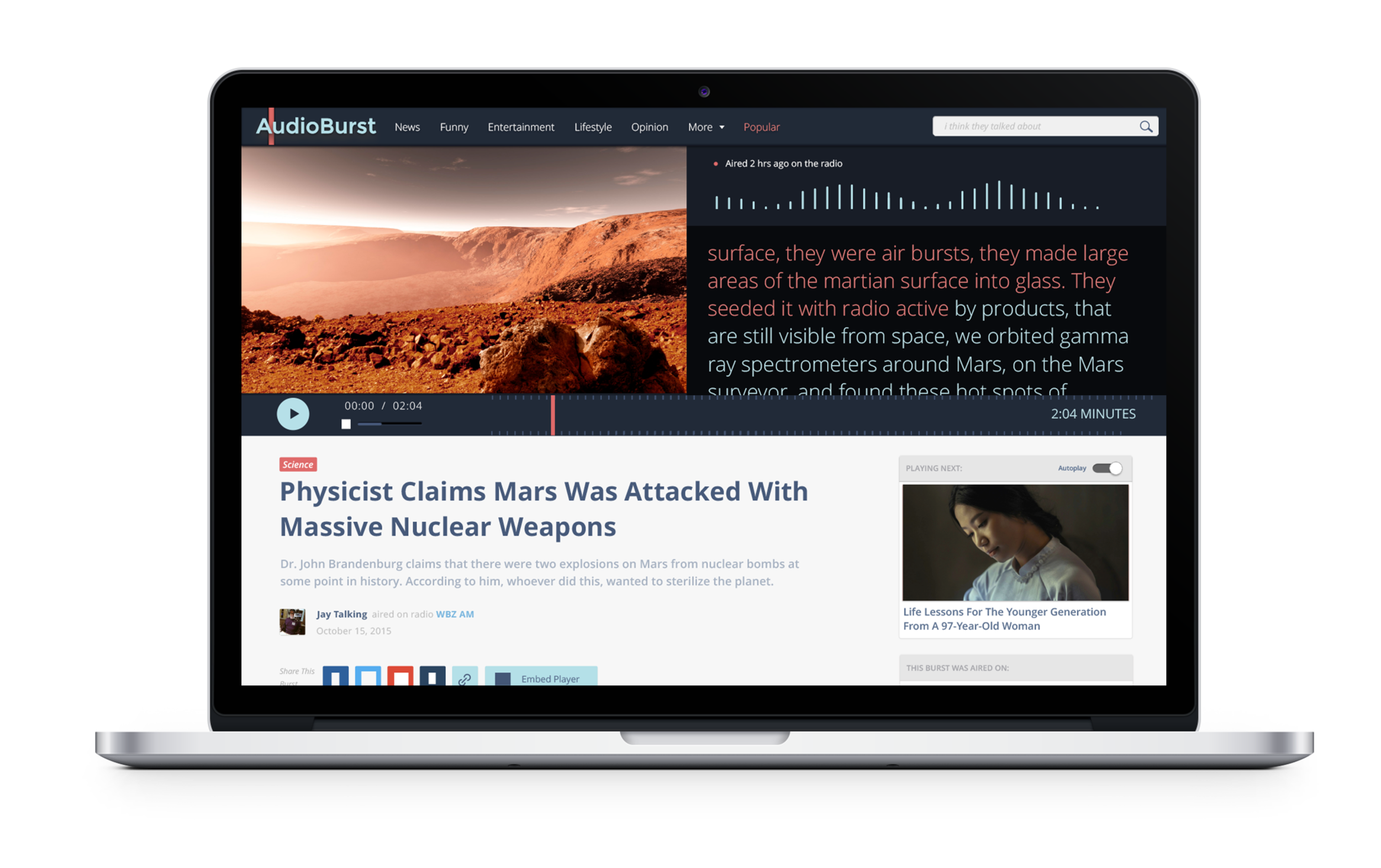

In collaboration with Ofer Shani, my role was to design a website that facilitates quick and intuitive searches of radio content, while also recommending captivating listening options based on user preferences. We delved deep into the essence of radio search experiences, exploring effective ways to represent and navigate audio content.
Confronted with the challenge of accurately transcribing diverse accents, we created a visually engaging interface to offset any transcription inaccuracies. This interface integrates text, audio visualizations, thematic imagery, and provides users with the option to suggest corrections.
This project has yielded a platform that not only introduces a novel interaction with radio content but also enhances the digital landscape with automatically curated articles, making ephemeral radio stories permanently accessible and discoverable.
BRANDING
Radio was at it’s peak in the 80s


Look & Feel of a Burst


An Article


How to make a burst go viral?


Audio is more likely to be consumed if funny, insightful or otherwise deeply impacting, but once aired, radio value vanishes. In order to create a viral burst, it must be able to be consumed “on the go” and easily extracted as a standalone post. And above all, easy to share. More advantages of audio segments:
*
*
*
*
Captures the vibe of the moment
Reveals the nuances and true meaning of things.
Emphasizing emotions
Providing an unedited version of reality
Website and mobile design
The Audioburst main page serves as a gateway to a seamless and intuitive radio search experience. It prominently features categorized content, including Science, Lifestyle, Entertainment, and News, with visually striking cards that pair audio clips with relevant images and descriptive titles.
Each card highlights the duration of the clip and the source, making it easy for users to explore engaging radio moments. The clean layout and focus on user preferences ensure that visitors can quickly find content tailored to their interests, while the integrated audio player allows instant listening without navigating away.
This design emphasizes accessibility, engagement, and the discovery of dynamic audio content.

The mobile version of the Audioburst ensures a seamless and user-friendly experience. At the top, users are greeted with a large featured audio clip and a clear play/pause button for quick access. Below, the title and source details are displayed for easy identification.
The design emphasizes clarity, touch-friendly interaction, and an engaging listening experience tailored for mobile use, which is always on the go. Interactive "Next" section suggests related clips for continuous engagement.
Further down, additional contextually relevant audio options can be found, ensuring that users can effortlessly explore similar topics.
Campaign
This social media campaign was all about making people smile. We played with the things people love most, creating playful slides like “Love us like you love yourself” and “Love us like you love your pillow.” Each post brought a touch of relatability, turning a simple like into a moment of connection and fun. Because, let’s face it, who doesn’t love free refills or their favorite slice of pizza?